[Punch-kun] What Is Punch Teaching These Two Baby Monkeys? You Won’t Believe Their Poses!
SEO Meta Description: Punch-kun and two adorable baby monkeys strike the funniest matching poses! Discover their hilarious little meditation class, sweet companionship, and heartwarming adventures at Ichikawa Zoo.
OMG! Is Punch-kun Teaching Two Baby Monkeys How to Meditate?
STOP EVERYTHING, because Punch-kun and his two adorable little companions might have just created the cutest monkey classroom ever!
Japan’s beloved young macaque is back with another unforgettable moment that has animal lovers smiling from ear to ear.
But this time, the excitement is not about chasing, climbing, or stealing someone’s favorite toy.
Instead, the adorable trio appears to be practicing something surprisingly peaceful.
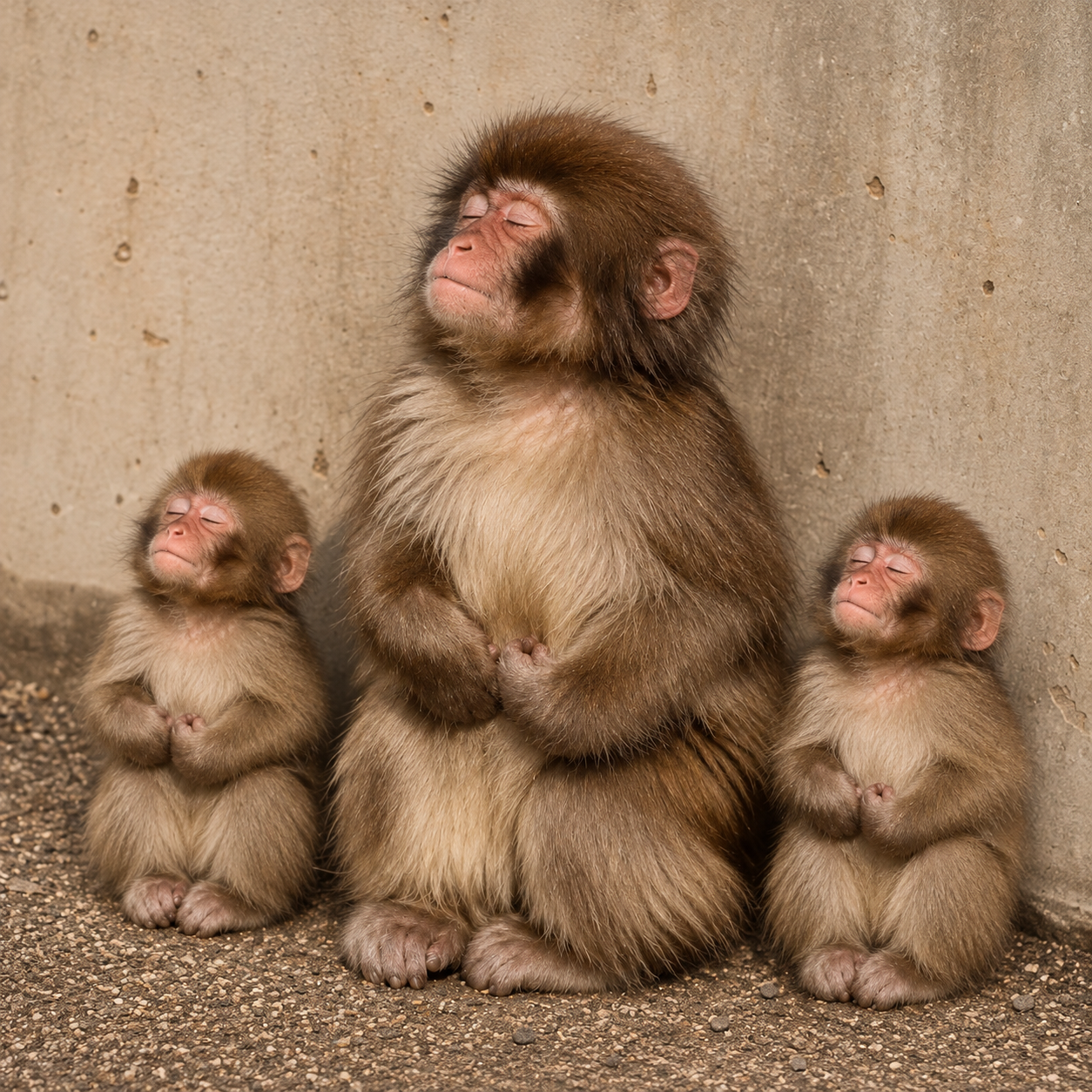
Imagine three fluffy little monkeys sitting together with their eyes gently closed.
Their tiny hands rest near their bellies as they strike remarkably similar poses.
For human viewers, the scene resembles a miniature meditation class.
And the funniest part is that Punch-kun looks like the instructor!
His two younger companions seem like the most adorable little students imaginable.
Are they copying their older friend’s relaxing posture?
Have these mischievous youngsters suddenly discovered the secret to inner peace?
Or is this simply another charming example of ordinary Japanese macaque behavior?
Whatever the explanation, the matching poses create an absolutely irresistible moment.
And Punch-kun’s remarkable journey makes the scene even more heartwarming.
Meet Punch-kun, Japan’s Famous Little Monkey
Punch-kun is a Japanese macaque born on July 26, 2025, at Ichikawa City Zoo in Chiba Prefecture, Japan.
His unusual early-life experiences transformed him into an international internet sensation.
Unlike most newborn Japanese macaques, Punch could not depend on normal maternal care.
Dedicated zookeepers stepped in to provide essential nutrition, protection, and developmental support.
During his earliest months, Punch became attached to a stuffed orangutan.
The soft companion gave him something familiar to hold during his vulnerable infancy.
Videos showing Punch embracing his oversized stuffed friend quickly attracted worldwide attention.
Millions of animal lovers began following his journey and hoping he would eventually develop friendships.
As Punch matured, he gradually gained experience interacting with other members of his troop.
Today, his continuing development provides new reasons for supporters to celebrate.
Three Monkeys, Three Matching Poses, and One Hilarious Question!
There is something wonderfully entertaining about seeing animals adopt similar resting positions.
When several young macaques sit close together, their movements can sometimes look remarkably coordinated.
A gently raised head or a relaxed body position can create an especially charming impression.
Now imagine two smaller youngsters appearing to follow the same peaceful routine as Punch-kun.
Their soft fur and tiny hands make the matching poses even more adorable.
For viewers, the gathering resembles a group of students following their favorite teacher.
The smallest companions almost look ready for their first lesson in monkey relaxation.
Of course, Japanese macaques do not operate meditation classes like humans.
Their similar positions may simply reflect comfortable ways of sitting.
But that natural explanation does not make the scene any less delightful.
Look at Those Adorable Little Faces!
One of the sweetest details is the peaceful expression of the young macaques.
Their gently closed eyes make them appear wonderfully relaxed.
Their tiny ears and fluffy coats add to the irresistible charm.
The soft expressions create an impression of complete concentration.
For viewers, they almost resemble children practicing a very serious breathing exercise.
It is easy to imagine someone whispering that the monkey meditation class has officially begun.
However, a closed-eyed expression does not automatically indicate meditation or deep sleep.
Japanese macaques may briefly close their eyes while resting in comfortable positions.
Their actual mental state cannot be determined from a single posture.
Nevertheless, those peaceful little faces are enough to make anyone smile.
Why Do Japanese Macaques Sometimes Sit in Similar Positions?
Japanese macaques have flexible bodies that allow them to adopt many resting positions.
They may sit upright, lean against surfaces, or settle close to familiar companions.
Their postures can change according to comfort and environmental conditions.
Several individuals occupying the same location may independently choose similar positions.
A comfortable resting surface can encourage a particular way of sitting.
Nearby companions may also respond to changes in the surrounding environment.
These circumstances can create surprisingly synchronized-looking behavior.
For Punch-kun and his little friends, matching postures make an especially entertaining story.
The appearance of coordination does not necessarily mean that one monkey is deliberately teaching the others.
Is Punch-kun Really Teaching the Baby Monkeys?
The idea of Punch-kun becoming a teacher is wonderfully funny.
However, deliberate teaching is a specific behavior that requires careful scientific evidence.
Young Japanese macaques do learn by observing other members of their troop.
They can become familiar with activities through repeated social experiences.
However, watching another animal does not automatically mean a formal lesson is taking place.
Similarly, adopting a matching posture does not prove intentional imitation.
For Punch-kun, nearby companions provide opportunities to observe and experience ordinary social behavior.
The playful teacher-and-students theme is therefore best enjoyed as an affectionate interpretation.
And the imaginary classroom is certainly one of the cutest ideas imaginable.
The Cutest Meditation Class on Monkey Mountain!
If Punch-kun really operated a meditation school, his classroom would be absolutely hilarious.
The rocky resting area would become the perfect place for a peaceful lesson.
Two fluffy youngsters would arrive as eager students.
Their instructor would settle into his most comfortable position.
The first imaginary lesson would be learning how to sit quietly.
The second would be practicing an adorable sleepy expression.
And the final lesson would probably involve staying relaxed for longer than a few seconds!
Of course, this is a playful human interpretation rather than a description of deliberate monkey training.
The comedy comes from how naturally the animals’ resting behavior resembles a familiar human activity.
From a Stuffed Orangutan to Real Monkey Companions
Punch-kun’s early experiences were very different from his increasingly social life today.
During infancy, his stuffed orangutan became an unforgettable symbol of reassurance.
Without normal maternal care, developing independence required additional support.
His caregivers gradually introduced opportunities for interaction with other Japanese macaques.
This process required patience because macaques live in complex social groups.
Youngsters must learn how companions communicate through posture, movement, and facial expressions.
As Punch matured, grooming and playful encounters became more familiar experiences.
Peaceful resting near other individuals also offered opportunities for social familiarity.
For longtime supporters, seeing Punch among other monkeys carries special emotional meaning.
And even an amusing matching-pose moment can remind viewers how much his life has changed.
January 19, 2026: Punch-kun Begins a New Chapter
Punch-kun began living independently within the macaque troop on January 19, 2026.
This important milestone followed months of specialized care and gradual preparation.
His caregivers had already introduced him to opportunities for interaction with other monkeys.
They carefully observed how he responded to familiar companions.
The goal was to help him participate in ordinary troop life.
However, joining the group did not mean every encounter would become immediately comfortable.
Japanese macaques have complicated relationships and established social expectations.
For Punch-kun, growing familiar with these behaviors became an important developmental challenge.
His continued participation in troop activities remains a meaningful part of his remarkable journey.
Why Baby Monkeys Learn by Watching Others
Young Japanese macaques develop important skills through experience and social observation.
They frequently pay attention to the movements of nearby companions.
Watching familiar individuals can provide information about their surroundings.
Youngsters also learn through exploration, physical play, and repeated interactions.
Different experiences help them develop coordination and behavioral flexibility.
Some skills become more familiar as animals mature within their social group.
However, not every shared action represents direct imitation.
Several monkeys may respond similarly because they encounter the same environmental conditions.
For Punch-kun, opportunities to observe other macaques are especially important because of his unusual upbringing.
Why Peaceful Resting Is Important for Baby Monkeys
Young Japanese macaques spend considerable energy exploring their surroundings.
Their everyday activities include running, climbing, jumping, and playful physical contact.
These movements help youngsters develop coordination and physical strength.
However, active animals also require appropriate opportunities for rest.
Quiet periods allow them to recover between demanding activities.
Sleep supports essential biological processes associated with normal development.
Different individuals may choose to rest at different times.
Several companions may also settle near one another when conditions are comfortable.
For Punch-kun and his little friends, peaceful resting is an important part of everyday life.
Are the Three Monkeys Really Meditating?
Meditation is a human practice involving deliberate attention and mental exercises.
There is no reliable evidence that these three macaques are intentionally performing human-style meditation.
Their similar sitting positions may simply reflect comfortable resting behavior.
Animals sometimes remain quiet while observing their surroundings.
They may also briefly close their eyes without entering a sustained period of sleep.
The complete behavioral context is necessary to understand what is happening.
Nevertheless, comparing the scene to a miniature meditation class is a charming storytelling idea.
It celebrates the humorous resemblance without claiming the monkeys understand human relaxation techniques.
And sometimes that playful comparison is exactly what makes a moment unforgettable.
Why These Two Baby Monkeys Make Punch-kun’s Adventures Special
Punch-kun’s social experiences have become an important part of his worldwide appeal.
His supporters remember when he depended heavily on a stuffed companion.
Many hoped he would eventually become comfortable around living macaques.
As his experiences expanded, encounters with younger companions introduced new moments of amusement.
Playful activities often create energetic and unpredictable situations.
Peaceful resting moments offer a completely different perspective.
The contrast makes Punch-kun’s continuing story especially interesting.
For viewers, two smaller companions striking similar poses create a delightful impression of friendship.
Their exact biological relationships cannot be established from appearance or proximity alone.
However, their presence provides another charming chapter in Punch-kun’s developing social world.
The Secret Behind Japanese Macaque Friendships
Japanese macaques maintain complicated social relationships within their troops.
These relationships develop through repeated interactions over time.
Grooming is one particularly important activity.
It involves examining and cleaning another individual’s fur.
The behavior can also contribute to maintaining social connections.
Youngsters may spend time near familiar companions during play or rest.
However, sitting close together does not automatically establish a permanent friendship.
Social preferences can change as individuals mature and experience new situations.
For Punch-kun, opportunities for ordinary contact remain more meaningful than identifying one particular best friend.
Why Punch-kun’s Funny Poses Are So Heartwarming
Punch-kun’s story began with circumstances that inspired tremendous sympathy.
His attachment to a stuffed orangutan became an unforgettable symbol of his unusual infancy.
Millions of people hoped he would eventually develop relationships with other monkeys.
His caregivers patiently encouraged appropriate opportunities for social development.
As Punch matured, reports of grooming and peaceful interaction brought encouraging news.
Now, adorable everyday encounters offer fans new reasons to smile.
The matching-pose theme is particularly entertaining because it transforms an ordinary activity into a miniature comedy.
It also provides a gentle contrast to the more energetic moments of monkey life.
For longtime supporters, that combination of humor and companionship feels especially meaningful.
The Dedicated Zookeepers Behind Punch-kun’s Journey
Punch-kun’s development has been supported by professional caregivers at Ichikawa City Zoo.
Hand-rearing a Japanese macaque requires specialized knowledge and consistent attention.
Caregivers must consider nutrition, physical health, and behavioral development.
They also prepare youngsters for appropriate interaction with their own species.
For Punch-kun, gradual integration into the troop became a central priority.
The zoo has emphasized that supporting his long-term welfare remains essential.
Its staff continue monitoring the macaques and managing their environment.
Opportunities for play, exploration, and peaceful resting all contribute to daily welfare.
Punch-kun’s continuing independence reflects the importance of responsible and patient animal care.
Why This Funny Monkey Moment Is Worth Watching
The matching-pose theme offers a charming perspective on ordinary Japanese macaque behavior.
Its playful title immediately creates curiosity about Punch-kun and his two companions.
Are the youngsters genuinely copying him?
Do their positions change as they become more comfortable?
And could the peaceful atmosphere suddenly give way to another energetic adventure?
These questions make the complete encounter interesting to explore.
Watching the full recording provides more context than one memorable moment.
For longtime supporters, Punch-kun’s development adds emotional meaning to everyday activities.
New viewers can also discover why this young macaque became an international internet sensation.
Sometimes the smallest animal moments create the biggest smiles.
Frequently Asked Questions About Punch-kun and His Two Little Companions
Who Is Punch-kun?
Punch-kun is a Japanese macaque born on July 26, 2025, at Ichikawa City Zoo in Japan.
He became internationally famous after being hand-reared and developing an attachment to a stuffed orangutan.
Is Punch-kun Really Teaching Two Baby Monkeys?
The teacher-and-students idea is a playful interpretation of the monkeys’ matching postures.
There is no confirmed evidence that Punch is deliberately teaching a formal activity.
Why Are the Three Monkeys Sitting in Similar Positions?
Japanese macaques may adopt similar resting postures because of comfort and surrounding conditions.
The complete encounter is necessary to determine whether any social influence is involved.
Do Japanese Macaques Practice Meditation?
Japanese macaques do not practice meditation in the established human sense.
Their peaceful sitting positions can nevertheless resemble familiar meditation poses.
Do Baby Monkeys Learn From Older Monkeys?
Young macaques gain experience through observation, exploration, and repeated social interaction.
These processes contribute to their physical and behavioral development.
Are the Two Baby Monkeys Punch-kun’s Siblings?
Their biological relationship to Punch-kun cannot be determined from their appearance or proximity.
Reliable information from the zoo would be needed to confirm a family connection.
Is Punch-kun Becoming More Independent?
Punch-kun has made encouraging progress through increasing participation in ordinary troop activities.
His growing social experiences represent an important change from his vulnerable infancy.
Where Does Punch-kun Live?
Punch-kun lives at Ichikawa City Zoo in Chiba Prefecture, Japan.
His continuing adventures attract attention from animal lovers worldwide.
Punch-kun and His Two Little Students Are Simply Too Adorable!
Punch-kun has come an extraordinary distance since his earliest days as a vulnerable baby macaque.
The youngster who once depended heavily on a stuffed orangutan is developing a richer social world.
His amusing matching-pose adventure offers another cheerful perspective on that transformation.
The idea of Punch leading a miniature meditation class is wonderfully entertaining.
Two adorable youngsters make the scene even more memorable.
Their peaceful expressions and similar positions create an irresistible impression of coordination.
Of course, the monkeys are simply living their natural lives rather than following a human lesson plan.
But the humorous resemblance makes the moment perfect for an affectionate story.
For longtime supporters, the most meaningful development is Punch’s continued participation in ordinary macaque life.
Every opportunity for peaceful companionship adds another encouraging chapter to his journey.
And sometimes three fluffy monkeys sitting quietly together can create more joy than the most exciting adventure.
Watch the Full Video: What Is Punch-kun Teaching These Two Baby Monkeys?
What happens when Punch-kun and two adorable youngsters gather for a peaceful moment?
Will their matching poses continue, or will their natural curiosity lead to another funny adventure?
Discover more of Punch-kun’s everyday life and enjoy another heartwarming chapter in his remarkable journey.